Tuesday, June 28, 2011

Program Notes


It’s easy to sit back and watch A Doll’s House because it is first and foremost a play about a marriage. You can watch the relationship unravel and leave the theater entertained without much fuss. You could do this, but you shouldn’t. Henrik Ibsen wrote A Doll’s House as a scathing indictment of his society and without knowing his society, you will miss the layers of social statements Ibsen included in his work. So let’s explore that, shall we?
1879 was the dawning of a new era. Norway was only beginning to interact with English-speaking peoples of the world during the period in which Ibsen wrote this classic. Most of the primary sources available are still in their original Norwegian and, due to it not being easily translated into English, were practically unreadable. Norway  was a nation changing along with all the others in the face of the Industrial Revolution.
The Industrial Revolution led to a surge of nationalism in Norway and the development of a culture unique to the Norwegian people. However, by 1874 the initial boom of the Revolution had faded, and the world sank into the first global economic depression that would last until 1896.
This production is set in 1879 in Christiania (now called Oslo), Henrik Ibsen’s hometown. Norway has been growing rapidly, tripling its population since the beginning of the century and Christiania has just annexed five new “counties” into its township. City life is not easy: it’s crowded, and noisy. Diseases like Smallpox, typhus and tuberculosis and cholera run rampant among the populace like it never has before. As the masses move in, so does prostitution and venereal disease. With little to no explanation as to treatment or cause, sex itself is blamed and suppressed. It is labeled dirty and a strong moral contraband is put on it outside of marriage. Marital sex is to be done only for reproduction. Torvald’s strict adherence to these rules is mostly to save his own reputation, but the moral codes put in place in this time as a whole are not intended to keep people down, but to keep them alive—such is the importance.
 The birth of Norwegian art is picking up steam: landscapes of the beautiful Norwegian scenery painted by Johan Christian Dahl pave the way for other Norwegian artists such as Kitty Kielland, Harriet Backer, Frits Thaulow, and Christian Krohg. Norwegian men are also well-educated, as all men were taught to read and write. It was very expensive for men to go to University. At University, there were a lot of tests for the students to take. Geography and history were emphasized in higher-level learning, though the English decided they were lacking in “gentlemanly bearing.” Torvald, of course, would scoff at this.  Women, of course, did not receive higher education until years after A Doll’s House was written.
Norwegian women, like most women around the world at the time, experience second-class status. Ibsen himself said that a woman “cannot be herself in the society of the present day, which is an exclusively masculine society, with laws framed by men and whit a judicial system that judges feminine conduct from a masculine point of view,” and that she is expected to “like certain insects…go away and die when she has done her duty in the propagation of the race.” Indeed, women were only just starting to fight for their rights: only single women were considered “independent adults” who could take care of their own assets. Married women, like Nora, surrendered all to their husbands. Nora was in fact based off of a woman named Laura Kieler, a good friend of Ibsen’s. Laura also had a secret loan, but her husband Victor divorced her and had her commited to an asylum. This is the society that Nora was raised in. This is what she walks into when she leaves her home.
Now let’s look at Nora’s debt from a modern standpoint so that we realize the gravitas of Nora’s situation: Nora borrowed today’s equivalent of $56,969 from Nils Krogstad. To put that into perspective, The average man in Norway in 1879  the equivalent of $7, 751 a year. Even after his promotion, Torvald would only have made around $15,311 per year!
By better knowing the world in which the events of A Doll’s House, the audience can better understand the implications of Nora’s plight, the society she’s up against, and just how loudly that slamming door resonates at the end of the play.

Monday, June 27, 2011

The World of the Play - Statement

Firstly, I have to take the time to say that researching the world of A Doll’s House proved to much more challenging--and exhausting than I ever thought it would be. Norway was only beginning to interact with English-speaking peoples of the world during the period in which Ibsen wrote this classic. Most of the information I sifted through was still in its original Norwegian and, due to it not being easily translated into English, was practically unreadable. What I did find was a nation changing along with all the others in the face of the Industrial Revolution. proved to be much more challenging—and
Norway was a small farming nation pre-revolution. It was owned by Denmark until 1814, when Sweden invaded and Denmark ceded Norway to the Swedes. The Industrial Revolution combined with the new, arguably less restrictive Swedish regime led to a surge of nationalism in Norway and the development of a culture unique to the Norwegian people. However, by 1874 the initial boom of the Revolution had faded, and the world sank into the first global economic depression that would last until 1896.
This production is set in 1879 in Christiania (now called Oslo), Ibsen’s hometown. Norway has been growing rapidly, tripling its population since the beginning of the century and Christiania has just annexed five new “counties” into its township. City life is not easy: it’s crowded, and noisy. Diseases like Smallpox, typhus and tuberculosis and cholera run rampant among the populace like it never has before. Louis Pasteur has only introduced his theory of bacterium and has trouble getting his fellow doctors on board with the idea. As the masses move in, so does prostitution and venereal disease. With little to no explanation as to treatment or cause, sex itself is blamed and suppressed. It is labeled dirty and a strong moral contraband is put on it outside of marriage. Marital sex is to be done only for reproduction. The moral codes put in place in this time are not intended to keep people down, but to keep them alive—such is the importance.
Not everything is too gloomy, however. The Church of Norway, which is of Lutheran Christian faith, has started as series of assemblies in order to democratize the formal proceedings of the Church.  Previously banned, Atheism and Judaism were made legal in the middle of the century. Our play takes place on Christmas Eve. Christmas, called Jul (pronounced like “yool”) was introduced to Norway in the 900s, when King Haakon I decided that the heathen custom of drinking Jul was to be moved to December 25th, in honor of the birth of Jesus Christ. It is a tradition in Norway to gather the family and make baskets of colorful paper to hang on the Christmas tree.
 The birth of Norwegian art is also picking up steam: landscapes of the beautiful Norwegian scenery painted by Johan Christian Dahl pave the way for other Norwegian artists such as Kitty Kielland, Harriet Backer, Frits Thaulow, and Christian Krohg. Norwegian men are also well-educated, as all men were taught to read and write. It was very expensive for men to go to University. At University, there were a lot of tests for the students to take. Geography and history were emphasized in higher-level learning, though the English decided they were lacking in “gentlemanly bearing.” Women, of course, did not receive higher education until years after A Doll’s House was written.
Norwegian women, like most women around the world at the time, experience second-class status. Ibsen himself said that a woman “cannot be herself in the society of the present day, which is an exclusively masculine society, with laws framed by men and whit a judicial system that judges feminine conduct from a masculine point of view,” and that she is expected to “like certain insects…go away and die when she has done her duty in the propagation of the race.” Indeed, women were only just starting to fight for their rights: only single women were considered “independent adults” who could take care of their own assets. Married women, like Nora, surrendered all to their husbands. Nora borrowed today’s equivalent of $56,969 from Nils Krogstad. To put that into perspective, The average man in Norway in 1879  the equivalent of $7, 751 a year. Even after his promotion, Torvald would only have made around $15,311 per year!
By better knowing the world in which the events of A Doll’s House, the audience can better understand the implications of Nora’s plight, the society she’s up against, and just how loudly that slamming door resonates at the end of the play.
Friday, June 24, 2011

Statement: Producing the Play

          A Doll House poses quite a few problems for anyone willing to take on the text. First would be the escalating nature of Dr. Rank’s infirmity. How sick is he? How far does it need to escalate? He is, after all, dying in the end. How do you show that on stage without distracting from the main action? Every production needs a letterbox that is noticeable but doesn’t divert from the entire set. The letterbox also needs to be see-through or have an indicator, something that Nora can’t hide so that Torvald can see it once Krogstad’s letter is delivered. The tarantella scene is one of the largest problems. This not a well-known dance, yet it is crucial as the climax of the play! It is also imperative to keep the play relatable, as it was written in 1879 and women’s rights have come a long way since then. The biggest problem by far, however is how to play Nora. Nora is very difficult because her personality supposedly changes between Act One and Act Two. It is of maximum importance that Nora be believable, even with her sudden and (not visible to the audience) change of heart.
            The first issue for the Sam Houston production is deciding on a space. Because the play takes place in one room and has a small cast and an intimate nature, I think the Showcase Theater would be the best location for it. The next problem is making everything accurate to the period, as I would set my production in Norway in 1879. Anachronisms are jarring to me as an audience member and shameful to me as a director or dramaturg. The production would be one of the few “straight plays” to need a choreographer for the tarantella, which should also be as authentic as possible. A problem that is very unique to Sam Houston is the need for a sturdy door! The door slam at the end is very famous and can’t be pulled off night after night with the current Showcase door. Finally, we might get the word out about the content of the play. It’s not too scandalous in this day and age, but in a community that prides itself on family values, the ending might ruffle a few feathers.
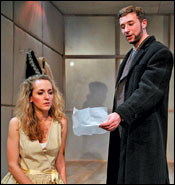
            Other productions have gotten very creative in order to solve the challenges Ibsen gives us in A Doll House. The Northern Stage production in 2008 featured a set with transparent walls, so that one could easily see all of the dimensions of Nora’s world, let alone the letterbox. Being able to see every aspect of her life allowed the audience to better believe the change of heart she has later in the play. Hiring a choreographer for the tarantella scene also seems to be a popular option, as both the Bated Breath Theatre Company and the Northern Stage credited one. Another popular option is to change the time period and country in which the play is set in order to make it more relevant to the audience. In January, the Infamous Commonwealth production was set in 1962 Manhattan, while Bated Breath and Northern Stage were set squarely in the 1950s.
            Critics are very touchy about A Doll House. They seem to go into the theatre thinking something along the lines of “this is a classic, but an outdated one. I hope they don’t mess it up,” as though they’ve seen it all from this play before. Some critics walk out of the theatre pleasantly surprised while others shake their head and say “I knew they’d mess it up.” Casting seems to be a big factor. The critics most know the play and have an idea in their heads as to what they should look like. Any deviation and they are disappointed.  The main difference between a good review and a bad one, however,  is nearly always the way Nora is played. If they become thoroughly invested in Nora’s character and believe it when she has her epiphany, then they end up loving the show. If they think Nora is too infantile, not infantile enough or don’t believe the epiphany, the entire show loses stars. It’s unfair but true that the show’s success hinges almost entirely on Nora but it just goes to show how careful the director must be in casting.

Thursday, June 23, 2011

Palm Beach Dramaworks 2009

West Palm Beach, Florida
October 16, 2009– November 29, 2009

Director: William Hayes
Scenery: Michael Amico
Costumes: Brian O'Keefe
Lighting: Ron Burns
Sound: Matt Corey
Adaptation: Frank McGuinness

Brandon K. Thorp - Broward-Palm Beach New Times
     But they are completely overshadowed by the walking meltdown that Margery Lowe insists on being from curtain-up to curtain-call. The whole idea behind A Doll's House is that Nora Helmer has so completely bought into received notions of wifely duty that she doesn't realize how little her painfully oblivious husband appreciates her or the sacrifices she's made, and how completely she has subjugated her identity to please him. But Lowe's performance throughout the first act shows us none of this. Her Nora is obviously acting, and not well. Her gestures are so big, her voice so full of such sugary affectation that you get the sense she'd rather dispatch with acting altogether and hang a sign around her neck reading: "This Is A Sham." Source

Hap Erstein - Palm Beach ArtsPaper
     Whichever it is, Ibsen does not help matters by having Nora’s “Click!” moment -- as Gloria Steinem would put it -- during intermission. It is not that Nora’s character has a huge contrasting arc, but rather it is an on-off switch. Although Dramaworks chose to produce a fairly new adaptation of the play by Frank McGuiness (Someone Who’ll Watch Over Me), his script does nothing to inject a more modern viewpoint or dramaturgy.  Source

Production History - Bated Breath Theatre Company 2008


NYC, New York
11 June 2008  –  21 June 2008

Director:  Helene Kvale
Scenery:  Michael Billings
Costumes: Lucy Brown
Choreography: Greg Webster
Adaptation: Helene Kvale

Loria Parker - TheaterScene.net
     It is indeed a noble effort for a budding young theatre company to take on an historically pivotal play as its premiere production. Yet, to its credit, that’s exactly what Bated Breath Theatre Company has done with Ibsen’s A Doll’s House. Bated Breath’s founder, and the play’s director, Helene Kvale, has fashioned a version of the classic that deserves admiration and acknowledgment. The play’s translation verbally and stylistically works well, as the story takes place in what appears to be the 1950’s instead of the late 1800’s. In an era that in many ways infantilized women, the ’50’s attitudes and gender roles were just the spark it took to ignite the feminist movement, gaining benefits that so many of us now enjoy. Source

Mark Blakenship - Variety 
     The latter results in shadow play: As Nora reveals that she illegally borrowed money to pay for the medical expenses of her husband Torvald (Luke Daniels), or as he coos that she's useless without him, other cast member skulk behind the scrims. Backlighting turns them into distorted silhouettes, suggesting the social pressures that constantly oppress the Halmers and keep them locked in their gender roles. Source

Production History - Infamous Commonwealth 2011

Chicago, Illinois
22 January 2011  –  27 February 2011

Director: Chris Maher
Scenery:  Katherine Arfken
Costumes:  Rachel M. Sypniewski
Lighting:   Mac Vaughey
Sound:  Chas Vbra
Adaptation:  Christopher Hampton 

Dan Jakes - Chicago Theatre Beat
     As Krogstad, baby-faced Josh Atkins neither looks nor sounds the part of a blackmailing antagonist. Nothing states that Nora’s nemesis has to be a deep-voiced, brooding menace, but Atkins presumes that archetype while not having any of the physical or vocal characteristics to back it up. The result resembles a boy wearing his father’s suit. Cares does her blustering best to seem intimidated by Atkins’ threats, to little dramatic avail. Source

Nina Metz - Chicago Tribune
     But the reason the play works — why it has always worked — is because it is the story of one marriage, not an indictment of all marriages. You don't want a show banging you over the head with its gender politics. You want it to make you to think. And that, unfortunately, is not the case with director Chris Maher's overly stilted production. Source  


Production History - Northern Stage 2008

Newcastle upon Tyne, Tyne and Wear, England
19 April 2008  – 31 May 2008

Director:  Erica Whyman
Scenery:  Soutra Gilmour
Lighting: Charles Balfour
Music: Leif Jordanssen
Choreography:  Liv Lorent and Caroline Reece
Adaptation: Frank McGuinness

Lyn Gardner - The Guardian
     The 1950s setting works very well; it is a period far enough away in time for the stifling social code of Ibsen's play not to jar, but modern enough to connect with today. Soutra Gilmour's startling design offers a wealth of period detail in a glass house where all is visible and yet both husband and wife are blind to the truth about their marriage. Source

Peter Lathan - The British Theatre Guide
     But what of the production? Designer Soutra Gilmour, in her fourth collaboration with Whyman at Northern Stage (they have also worked together before at the Gate in Notting Hill), has produced a glass house, through the walls of which we can see, apart from the living room, Helmer's study and a passage way together with the front door of the house, and beyond that into the street. The walls are etched with the same design as the wallpaper on the tormentors which turn the open space of Stage 1 into a proscenium. Based on a Jacobean wallpaper design, it has, appropriately, a very Aubrey Beardsley feel. Source

Bonus! Videos:

Erica Whyman Speaks about A Doll's House
Scenes from the Production